Sunday, June 10, 2018

Tetraneuris acaulis - ever-blooming heat lover

Hymenoxys acaulis is now recognized as Tetraneuris acaulis or Angelita Daisy. "Acaulis" refers to the fact that this plant has no stem. Flowers arise directly out of a base of needle-like thin leaves. Flowering stems have no leaves, just a thin stalk with a golden daisy on top waving in the wind. The stalk of this member of the Asteraceae Family is about 12 inches tall. The grassy base of foliage gradually increases in width as it grows. This plant blooms year-around with these cheerful yellow daisy flowers that are popular with pollinating insects. Photo below of a fly nectaring on a flower. The flowers are flat and dense and easy for the tiniest pollinator to land on and feed. The bright golden yellow flowers are visible for a long distance. I really like this plant because it is so easy and gives so much back. The flowers are non-stop and it really loves heat, but not too much heat. Extended periods of 100 degree days can shorten the life of this native plant. It is hardy down to zero degrees Fahrenheit. It is very drought tolerant but appreciates a little water occasionally. 
Tetraneuris acaulis bloom with fly                                                                                                      S. Reeve

Tetraneuris acaulis                                                                                                                                 S. Reeve
This plant can really cover itself with blooms. After the flower fades the stalk is left. To neaten it up deadhead the spent stalks when they become numerous and noticeable. 


This plant is native to the western half of the US with the exception of Oregon and Washington. Depending on the location, there are 5 highly variable subspecies of this plant. California and the Southwest is home to Tetraneuris acaulis var. arizonica (Tetraneuris acaulis (Pursh) Greene var. arizonica (Greene) K.F. Parker). This plant is found at 1300-2900m in grasslands and hillsides. The California population is found in and around the Mojave National Preserve. I am always fascinated by the adaptations a plant makes for its environment. In this case, compared to Tetraneuris acaulis, Tetraneuris acaulis var. arizonica is stockier and covered in downy hairs and the foliage appears silvery-gray rather than green. The flowers and foliage are more substantial and fleshy. Increased sunshine and less precipitation make this version better adapted to life in the Southwest. 
Photo ©Al Schneider, http://www.swcoloradowildflowers.com


As is the case for so many Southwestern natives, this plant must have good drainage to survive. It becomes susceptible to fungal infection if drainage is less-than-ideal. The literature says this a short-lived perennial. I haven't grown it long enough to know if this is true, although, it seems that perennials that bloom constantly poop out faster than plants that don't. 

Angelita Daisy combines well with other plants. As an example, here is Eremophila hygrophana with another desert daisy, Baileya multiradiata, but this could easily be Tetraneuris acaulis. You can also combine it with smaller Leucophyllum selections, Salvia greggii, Agastaches, Eremophila maculata 'Valentine', native Calliandras, Hesperaloe parviflora etc. It would also be nice to plant a mass of this plant. It is rabbit resistant. 
Eremophila hygrophana and Baileya multiradiata                              S. Reeve


Friday, April 6, 2018

Small but Important


Croton setiger                                                                                                                            S. Reeve

You have probably seen this plant while hiking, or possibly while driving since it likes to grow in road cuts and disturbed areas. Even if you saw it, you may not have even noticed it since it blends with the landscape and has a really low profile. The plant has the peculiar name of Croton setiger or Dove Weed. This annual grows mainly all through California and into Western Oregon and Washington, and down into Baja. In San Diego, we are at the bottom of its range, as it needs, at minimum, 9 inches of rain a year. This plant grows at low elevations but can be seen up to around 2500 feet above sea level. It can be found in dry soils in CSS, oak woodland, and in grassland habitats. It blooms for a long period of time from spring into fall. Not that you would notice because the flowers are tiny, about an eighth of an inch and they blend into the foliage. The foliage has a lemony chemical smell.


Croton setiger Doveweed                                                                                                  S. Reeve
Why I love it and why I noticed it, is when you get down and look at the flowers they are covered in tiny native pollinators like this blue wasp. This wasp is probably a Spider Wasp or Aporus luxus. This was the best photo I could get with a cell phone. I kind of cut his head off in the picture. What a startling blue! I could have spent all afternoon watching the little pollinators scrambling around on the tiny flowers. It looks like flowers presented on white dinner plates. 
                  Blue wasp (Aporus luxus) on Croton setiger                                                          S. Reeve   

Ron Vanderhoff 


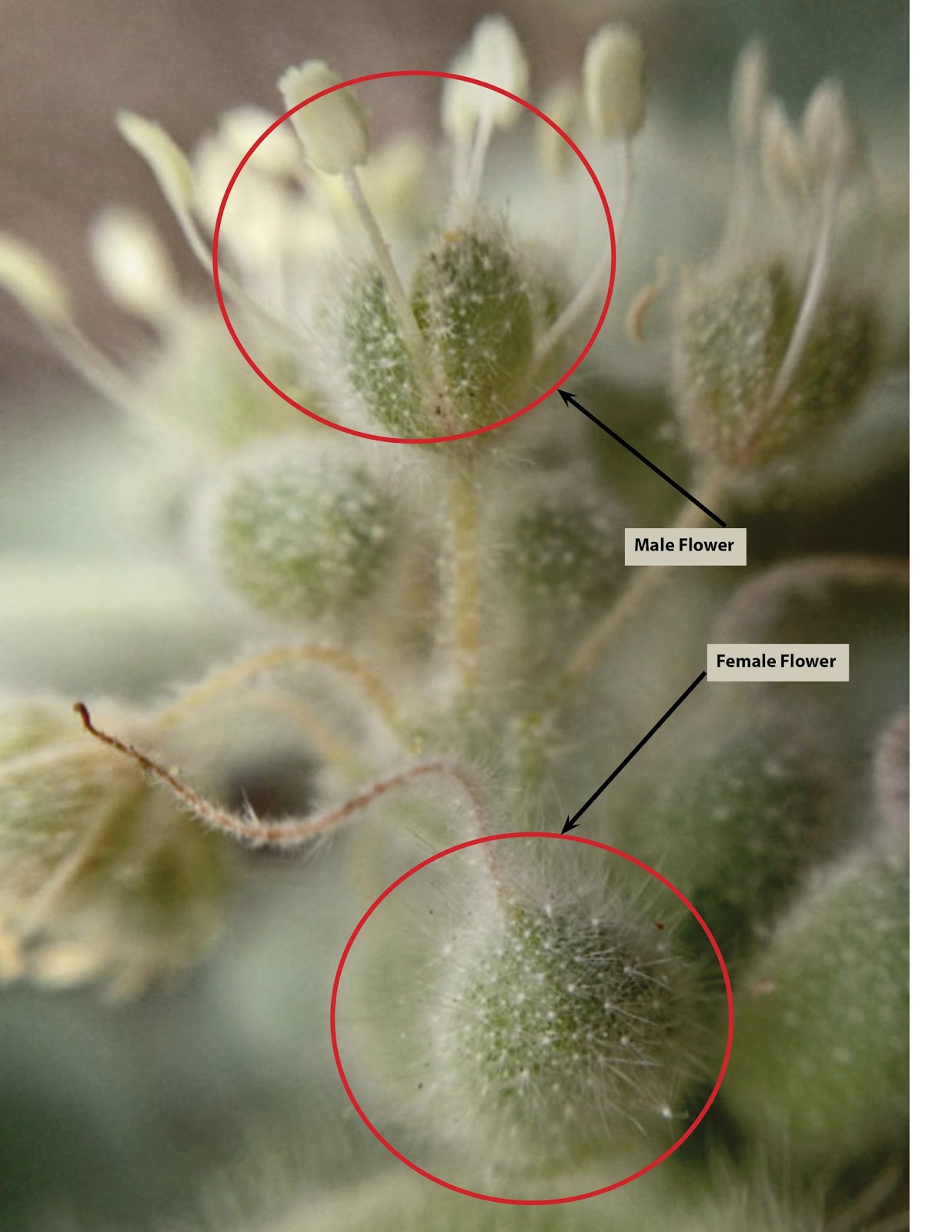
From what I could find the flowers offer pollen in the male flowers presented at the branch tips, and are very accessible to tiny pollinators looking for lunch. Male flowers have no petals but have sepals and stamens. Female flowers are in the axils. The female flowers have no petal or sepals and are just a single swollen ovary with a style sticking up. Not sure how this very unenticing flower gets pollinated? Turns out the beetles probably do it. They are not efficient pollinators, so when they are bumbling around on the male flowers there is plenty of pollen that drops into the female flowers lower down on the plant. Thank you to the Natural History biologists at UCI for the great macro photography, especially to Ron Vanderhoff, so I could understand the flower structure. http://nathistoc.bio.uci.edu/plants/Euphorbiaceae/Croton%20setigerus.htm


This plant is entirely covered in irritating dense hairs, except for the seeds, and chemically defended against herbivory, but it gives its non-toxic seeds away freely. It is in the Euphorbiaceae and the leaves are toxic and were used as a fish poison to stupefy fish by local Indians. They are a favorite food of birds that forage on the ground like quail and doves. Nutritious seeds are about an eighth of an inch long and can be either speckled or unmottled gray. This may be a reproduction strategy so that some seeds are not recognized as food and go on to germinate. Notice the unmottled seed in the upper left.
J. O'Brien 2007

You can find seed to start this plant. It would seem to me to combine well with spring wildflowers like California poppies and others. The plant forms a low-growing mound less than a foot high and can spread up to 3 feet wide. It is just beautiful to see the neat silvery soft mounds of foliage. I wonder if any nursery has tried to grow this as a retail plant? Anyway, I love it for its silver color, neat habit and popularity with pollinators. Look for it on your next hike. 


Tuesday, November 21, 2017

New Exciting Salvia x 'Anthony Parker'

Learning new plants for the wildlife garden is always thrilling for me. Normally, I concentrate on natives, but I garden for wildlife and the late summer-fall native garden does not offer much for the hummingbirds I love so much. Additionally, my job as a Horticulturist and Garden Designer requires me to know about all plants that work in San Diego gardens. My landscape is a living laboratory where I grow new plants to learn more about them. Excited about a new Salvia for me. This choice plant is a chance cross between Salvia leucantha and Salvia elegans found by Frances Parker in her Beaufort, South Carolina garden, and named for her grandson, Anthony Parker.

I love salvias, and really love how fall-blooming salvias fill such a vital roll in supplying flowers when not much else is flowering. Salvia leucantha has always seemed a little insipid to me as the blooms have so much white. Salvia x 'Anthony Parker' takes care of that with deep lush purple blooms that are long-lasting. It is hardy from USDA Hardiness Zone 7-10. I will be able to tell you more about care instructions when I have grown it for awhile. Here is a photo by Adrian Kuys of Australia. Hummingbirds are especially thankful for fall-flowering plants in the garden. My goal is to provide a smorgasbord of edible plants, flowers, and fruit for as much of the year as possible. In my Zone 10b garden it doesn't freeze, so that smorgasbord is open pretty much all year long. Good to know they will be eating well this Thanksgiving!


 Salvia x 'Anthony Parker'                                                                                                                       Adrian Kuys


Saturday, August 26, 2017

Ever Wondered about the Sex Life of Holly?

Ever wondered about the sex life of holly? Well, I have, and let's just say it is complicated! What I am referring to is the genus Ilex, specifically landscape selections of Ilex. Now I know I usually talk about native plants, but this is a topic that is confusing and attractive to delve into, and delve we must! Let's look at several landscape hollies: Red Hollies, Nellie R. Stevens Holly, and Mary Nell Holly.

Naturally Ilex species are dioecious. Dioecious means "two houses" in Latin to reflect the fact that Ilex has male or female flowers on separate plants. Only about 10% of plant species have this condition. Most plants have "perfect" flowers, or male and female parts on each flower. For the benefit of future generations of plants being more fit for their changing environment, plants usually have various mechanisms in place to avoid self-pollination. Dioecy is just one such manifestation. The number of variations on this theme are amazing and clever. Mother Nature is the master at improvisation! Look at the two photos below. The first one is of a female flower. These are easy to distinguish from the berry-like protuberance in the center of the flower. Male flowers lack this structure and have pollen-bearing anthers. The male flowers are so numerous and carry such a large pollen load, that blooming hollies are irresistible to bees. To get berries on your hollies, you must have a male holly that blooms at the same time as the females. As long as there is a male somewhere in the vicinity, bees will locate it and pollinate your female hollies. Bees are amazing!

Ilex female flowers                                                                                                                                                    Wikipedia
   
Ilex male flowers                                                                                                                                                      Wikipedia

Plant breeders have managed to cross several species to achieve various goals, such as greater cold tolerance, and fruit set. Some crosses resulted in female plants that can set fruit without a male holly. These crosses usually contain some Ilex cornuta, or Chinese Holly, since Chinese Holly exhibits a condition called parthenocarpy. Parthenocarpy is the ability of a female plant to form sterile fruit in the absence of a male. Several plants can do this. The trait of parthenocarpy was used to breed "seedless" citrus and other plants. 
To complicate matters, Ilex cornuta, and its hybrids, sometimes have perfect flowers on male plants, followed by red fruits. These fruits contain four apparently normal-looking carpels, which may-or-may-not be viable. 

And then it becomes complicated! There is a group of hollies bred for size and color, referred to as "Red Hollies." They were developed by Mitch Magee's Evergreen Nursery in Poplarville, Mississippi. The name comes from the red tint on new growth. These are upright attractive plants with a strong pyramidal growth habit. This group includes Ilex 'Festive", Ilex 'Cardinal', Ilex 'Oak Leaf', Ilex 'Little Red', and Ilex 'Robin'. 'Oak Leaf' Red Holly has a confusing and complex breeding history. I was curious if parthenocarpy or plant sex through pollination was working to form berries. In an effort to understand the formation of fruit on the Oak Leaf Red Holly, I emailed several holly experts, and did some research. 'Oak Leaf' Red Holly has functional male and female flower parts, perfect flowers, so it can pollinate itself, so no parthenocarpy, just fertilization. The parent is an open-pollinated Mary Nell holly. Mary Nell is a three-way hybrid. Oak Leaf has an unknown male parent. Unlike normal dioecious hollies,‘Oak Leaf’ is not female but a hermaphrodite.


The Red Hollies, as a group, are a perplexing bunch of hybrids.  All are claimed to be open-pollinated seedlings of 'Mary Nell', which is itself the result of controlled hybridization and is Ilex (cornuta 'Burfordii' × pernyi) 'Red Delight' × latifolia). You can imagine all of the male pollen flying around at a holly propagation grounds, and that is why the identity of the male pollinizer remains a mystery. Oakleaf holly ('Conaf') and its branch sport Oakland ('Magland') are variously listed on gardening websites as male, female, and both. The US Plant Patents on these cultivars says the flowers are "perfect", meaning having functional male and female parts.  These plants do not have female flowers, as are present in most familiar hollies, (i.e. lacking a visible pistil), nor do they have male flowers (which lack functional pollen-bearing anthers).  Rather, their flowers have small pistils surrounded by four pollen-bearing anthers.  Botanically speaking, these would be considered androgynous, or hermaphroditic.

There is another Oak Leaf holly, Ilex 'Festive" ('Conaf'), which displays a different twist on plant sexuality.  This plant appears to be andromonecious, that is, bearing both traditional male flowers, as well as occasional perfect flowers.  It does not, however, seem to bear any female flowers.  In each blooming season, the vast majority of the flowers are male, and appear to have moderate amounts of pollen.  The perfect flowers tend to appear at the end of the blooming cycle, and produce misshapen, red fruits. 


As for male pollenizers for Oakleaf holly, it seems that this plant does not produce a lot of fruit because of its complicated genetics. I communicated with Dr. James Resch, Ilex specialist, and he says even in nursery settings, where pollen from many species and hybrids is available, Oakleaf holly never seems to develop numerous fruits. It may be that the plant's complicated pedigree has created so many chromosomal mismatches, with would-be pollenizers, that effective pollination can only rarely happen.
Ilex aquifolium                                                                                                                                                       Wikipedia

Two other super popular hollies are also the result of genetic crosses. They are gorgeous with their pyramidal habit, large and glossy foliage, and, of course, the beautiful berries. Both Ilex 'Mary Nell' and 'Nellie R. Stevens' have anthers that do not produce pollen, meaning that they do not have functional male flower parts. These two plants produce fruit through parthenocarpy and by being pollinated by a male I. cornuta or I. pernyi. A male selection suggested as a pollenizer is 'Edward J. Stevens'. 'Nellie R. Stevens' is the result of a cross between Ilex cornuta and Ilex aquifolium. Normally, Ilex aquifolium does not grow well in the heat and humidity of the South, but with the addition of Ilex cornuta genes, 'Nellie R. Stevens' is a long-standing staple in Southern gardens. 'Mary Nell' is a three-way cross with Ilex cornuta, Ilex pernyii, and Ilex latifolia. It is still helpful to have a male holly that blooms at the same time to increase fruit set. It is thought the almost ANY male holly that blooms at the same time will work, but I do not know this as a fact. 
Nellie R. Stevens Hollie                                                                                                                             John Paul Endicott

How to Have a Bee Friendly Garden

Nothing excites me more than to see wildlife in my garden attracted by the plants I bring in, and the wildlife-safe organic gardening practices I follow. This week at the Master Gardener Conference, Dr. Gordon Frankie, the highly respected professor and entomologist, gave us research-based tips on how to maximize native bees in the garden.  

My pollinator garden                                                                                         S. Reeve          


Native bee diversity is promoted by providing at least twenty different blooming plants. Different species of native bees will be attracted by different plants. When you maximize choice, you automatically increase your chances of attracting a wide variety of native bees. Of the estimated 3,600 species of bees in the United States, California is home to about 1,600 species of bees. You may have never noticed many bees before, but once you become interested in seeing bees in the garden, you start to develop “bee eyes” and you will see them everywhere. 

Many native bees are very small and very fast, and you may think they are flies, but some, like the Carpenter bee (Xylocopa varipuncta), are easily recognizable, about an inch long, and so entertaining to watch. Good plants to attact Carpenter bees are Leucophyllum frutescens, Senna  and Wisteria selections, and Caesalpinia mexicana. Wisteria flowers, in particular, have large flowers that only a large bee can open. Interestingly, Xylocopa varipuncta, is a sexually dimorphic species, and the males and females do not look at all alike. Males are often called, “teddy bear” bees because of their furry brown bodies. While females are shiny black with a violet cast. Males set up nesting territories that they patrol, looking for unmated females.  Using glands in their thorax, males release a scent that perfumes their territories. Females chose mates based on the quality of the fragrance. Unlike most bees that only live a matter of weeks, female Carpenter bees can live for several years.
Xylocopa varipuncta female on Caesalpinia mexicana                                                                                            S. Reeve
Once you develop “bee eyes” you will start to see the differences in the small flying insects, and you will recognize that bees look different than flies, and even wasps. Important differences include the fact, that bees generally have hairy or furry bodies, while wasps and flies do not.  Female bees also carry pollen on various locations on their bodies. The fur on their bodies makes it easier to do this. Bees and wasps, like other members of the Hymenoptera, have a narrow constriction in their midsection. Hence the term, “wasp waist.”  Flies do not have this. Bees and wasps also have two pair of wings, compared to only one pair for flies.  There are some flies that are excellent bee mimics, they even have the striped furry bodies, but the number of wings and lack of a mid-section joint gives them away. 

Bombus vosnesenskii gathering pollen from California poppy                                                                            S. Reeve

Besides, the wonderful bounty of life your bee garden will attract, bringing in bees will help you with your vegetable garden. Native bees are terrific pollinators. Be sure an include Lavendula ‘Provence’, a particularly enticing selection for bees, in your vegetable garden to bring in more pollinators. Let herbs and vegetables go to flower to attract even more bees. Kale, cilantro, basil and others will be covered in bees if allowed to flower.  If you are an early riser, go look at your squash blossoms, and you will certainly see the medium-sized Squash Bee (Peponapis pruinosa) deep in the squash flower. 
Peponapis pruinosa in squash blossom                                                                                                                    S. Reeve

To attract the most bee diversity,  plan your garden in the sunniest area, and include plants that have a continuous succession of bloom from February through October. In California we are lucky to have bees in the garden for most of the year.  Having flowers for most of the year, will insure a good food source for the many species of bees that nest all through the year, and often, multiple times during the year. Bees are natural searchers, and will soon find what you have planted. Experiments show, that even in the most urban gardens, bee diversity can increase dramatically if flowering plants are added. Plants in the Asteraceae, Lamiaceae, Rosaceae, Polygonaceae, Malvaceae, and Papaveraceae are particularly attractive for bees. Bees gather pollen and nectar, but not necessarily in the same plant. Pollen is used to provision the nest as food for bee larvae, and nectar is a food source for adult bees. A broad assortment of flowering plants will provide something for many different species.  Plant in large patches of at least 2 square meters, so bees can easily locate the flowers. Flowers in blues, whites, and yellows attract the most bees. 
Bombus melanopygus on Echium fastuosum                                                                                                           S. Reeve

While native plants are certainly important for feeding and nesting bees, non-natives fill an important role, as they bloom in the summer, when many natives are dormant. Some of the best bee plants are: Echium, Arctostaphylos, Phacelia tanacetifolia, Nepeta, Caryopteris, California poppies, Cosmos bipinattus, Ceanothus, Encelia, Gaillardia, and Calandrinia. Be sure to garden without pesticides, particularly neonicotinoids, to keep your bees safe.

Monday, December 19, 2016

Wildlife Habitat Garden in Southern California

I love wildlife gardening myself. Plants are great, but they are even better when the attract wildlife! It adds the element of activity and drama to the garden.

For a wildlife garden, you need plants of different sizes for different functions. One of the best investments you can make in attracting wildlife is to plant a native oak, such as a Quercus engelmannii or Quercus agrifolia. If your garden is not that large, a scrub oak, Quercus dumosa, will be more in scale. Oaks are special as they support more wildlife species and life forms than any other plant--by far! Their ecosystem value is unprecedented. Hundreds of species of organisms have evolved and developed relationships with native California oaks. 


Live Oak Quercus agrifolia
So you have your oak planted, what next? Make sure you have a source of water. I know that "water" is not a plant, but when you think about it, water is a scarce commodity in Southern California. Gardens with a water source will definitely attract more wildlife. 
Hooded Oriole in water feature
Now we need a diverse selection of plant material to either serve as nesting locations, sources of food, or sources of shelter. It is true, if you plant it, they will come! I have built many wildlife gardens, and it never ceases to amaze me, the increase in numbers of wildlife species, once the plants are in and growing. If you have a small property, selecting plants with numerous benefits for wildlife is key in maximizing a wildlife garden. For example, planting a native grape, like 'Roger's Red' on a chain link fence will eventually feed bees with pollen, and feed birds, and other wildlife, with fruit. Tiny bees in the Halictidae Family are often not seen, but are important pollinators for this, and other native plants. The tangle of vines can also house nesting birds. It is important to be a messy gardener if you want to provide opportunities for wildlife. Unpruned trees and shrubs provide the density of structure that can keep a nesting bird safe from predators. Also, stacks of branches and/or rocks can house reptiles and other wildlife.
Vitis 'Roger's Red'
Another favorite native California tree for wildlife is the California Sycamore. Did you know the fuzz found on the backside of the leaves is a major nest-building material for Anna's hummingbirds? If you have the room, plant this tree too. Another small tree option is Prunus ilicifolia. This slow-growing tree has spine-tipped glossy green leaves and is a beautiful plant, but when you think about the wildlife it attracts, it becomes even more valuable. It has flowers, fruits, and thorny cover for birds. Do you know the Toyon or Heteromeles arbutifolia? This is a great drought tolerant plant. If you have a smaller garden, use this plant as a tree with the Quercus dumosa as another small tree. Toyon is great as it has flowers in the spring that feed many small insects and bees, plus fruit in the fall for the migrating birds. The tree structure can provide nesting sites too. 


California Sycamore Platanus racemosa

Attractive Arctostaphylos trunks
A step down from a "tree" size plant is the shrub Berberis nevinii. This wonderful blue-green evergreen plant has thorny leaves that protect nesting birds, and copious small blooms for a wide variety of insects. This shrub becomes loaded with small, choice, ripening fruits later in the year that feed many bird species. Another shrub for a deep soil location is Frangula californica or Coffeeberry. This plant likes a little more water than the plants I have previously mentioned, but once again is multi-purpose wildlife attractor with flowers, fruit and cover. I have never seen so many species of pollinators and small native bees on one blooming plant, as this one attracts. Mistakenly known to be fickle or short-lived, Ceanothus, especially Ceanothus 'Ray Hartman' is another one with valuable and popular flowers and fruit, plus it is a gorgeous plant! Longevity can be improved by allowing the plant to go dormant in the summer. Native gardens are not complete without some species or selections of Arctostaphylos. The tiny urn-shaped blooms feed hummingbirds in the winter. This red-barked evergreen is so attractive in the garden. Another bonus with these plants, is many act as caterpillar host plants--so food for baby caterpillars too!
Ceanothus 'Ray Hartman'

Smaller shrubs like the evergreen Galvezia speciosa or Island Snapcracker bloom often and are an important hummingbird plant. Another drought tolerant shrub, that is popular with both hummingbirds and bees is Peritoma arborea, with gorgeous golden blooms even when other plants are suffering from drought. No wildlife garden is complete without at least one Salvia. Salvia apiana is a beautiful white-foliaged plant with wands of tiny white flowers popular with hummingbirds and bees alike. Salvia munzii is a small shrub that is drought tolerant and also tolerant of gardener-applied summer water. Salvia clevelandii is native to our area. Other small native shrubs, like Mimulus and California fuchsia, also feed hummingbirds and bees. If you like hummingbirds, Calliandra californica must be included in your wildlife garden. This red-flowered plant is rarely out of bloom and is a dependable nectar source for hummingbirds. Broadcasting poppy seed in the fall will make many native bumblebees happy. Abutilon palmeri is also a "must have" plant, known for its ever-blooming nature and its silver felty foliage. 
Salvia clevelandii
Epilobium canum ssp. latifolium

Abutilon palmeri


Here are a few smaller plants that really attract bees. Salvia 'Bees' Bliss' is a big magnet for bees. I found a "super plant" this summer, while hiking. This little unassuming plant was literally covered in all sizes of bees and wasps. Croton setigerus is its name, and it is often called "Dove Weed." It is a low-growing plush-leaved plant with tiny white flowers. Notice the tiny bright blue wasp in the photo! The next plant is Grindelia stricta ssp. venulosa, and it is loved by bees. It is also long-blooming if it gets a little additional water. One of the best bee-attracting plants is in the last photo of Phacelia tanacetifolia. This is an annual plant that gets constant bee attention. 


Croton setigerus


           Grindelia stricta ssp. venulosa


Phacelia tanacetifolia

I hope this little introduction to native California plants that attract wildlife is helpful. Nothing excites me more than to see wildlife in my garden attracted by the plants I bring in, and the wildlife-safe organic gardening practices I follow. Do the plants have to be native plants? No, but because the native plants and the local wildlife have evolved together and optimized their relationship through time, I believe the greatest benefit for local wildlife is provided by native plants, especially local native plants. Realistically, I have had some challenges growing California native plants, and I tend to trust the less "finicky" species because I do not like garden failure. All of the plants I introduced in the above blog are of this variety. Hey! Take it slow if you want. Just start with one native plant, and hopefully, it will lead to more. The activity it brings into your garden is addicting and exciting!

Bombus vosnesenskii on California Poppy